
Buying guide · 4 min read
Questions to ask when buying a used hybrid or EV
Battery, charging and cooling details can outlast the information in a listing.
Updated Nov 2026
Start with the way you’ll use it
Write down how far you typically drive, where the vehicle will park overnight, and whether you can charge there. Think about a winter trip over a Cascade pass as well as a mild-weather Portland commute. Cold weather, highway speed, cabin heat, climbing and cargo can all affect energy use. A dashboard range estimate changes with recent driving and conditions. Ask the seller how they used the vehicle, when they last charged it, and what range they usually saw on a trip like yours. Treat the answer as context for planning. Ask about actual charging stops rather than assuming the advertised range will determine where you stop.
Get the charging equipment and records in writing
Ask for a list of everything included in the sale. That might include a portable charging cord, plugs, adapters and keys. Photograph the labels and check compatibility with the car and the outlet or station you expect to use. For a plug-in, ask whether the charging port has been repaired and whether the car has charged reliably at both home and public stations. A seller’s ability to demonstrate charging can depend on location and equipment. If you want a demonstration, agree on the charger and permission before the appointment. Ask the seller to explain how the vehicle identifies a charge interruption and whether one has happened recently.
Ask about the battery and cooling system
Request invoices for high-voltage battery work, cooling-system service, software updates and warning-light diagnosis. Ask whether a battery was replaced as a complete assembly or repaired in part, and have the seller show you the work order. Record dates and mileage. For a hybrid with an engine, ask which services applied to the engine as well as the electric drive. A shop familiar with the model can explain the service intervals and whether any battery coverage transfers. If a seller advertises a battery-health percentage, ask what tool produced it and on what date. Compare readings only when their methods are comparable.
Look beyond the electric drivetrain
Electric and hybrid cars still have tires, brakes, steering, suspension and a body that can take damage. Ask to see tire invoices and note whether the tires match. On a car driven on wet Portland streets, think about the tread you’ll need for daily use, not just whether the tread will last until summer. We look for visible underbody damage, uneven tire wear and accessible evidence of leaks or corrosion. A car can have been used on mountain roads treated for snow even if it is now parked in the city. Ask where it spent previous winters and include that history when you book.
Set up a useful inspection visit
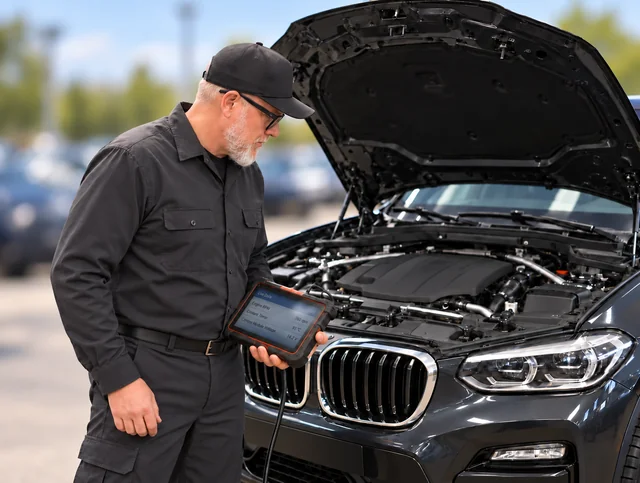
Give us the year, make, model and seller’s address. For a dealer, identify which location has the car. Mention any recurring warning, charge interruption, noise or low-range concern, and say when it occurred. We check accessible equipment and scan supported systems when possible. What we can read varies by vehicle and tool. Ask the seller to leave enough charge or fuel for the agreed checks. If you are buying from outside the area, ask the seller to confirm that we can operate the vehicle and access the charge port. Your report will explain checks that could not be completed.
Use the report to plan the next step
Separate observed issues from questions that still need testing. A stored code may call for further diagnosis. A limited scan or a short test drive does not establish remaining battery life. If your decision depends on a battery capacity figure, arrange a model-specific test before purchase and ask the shop what it measures. Bring the report, service records and the seller’s claims to that discussion. Decide what evidence you need before setting a price or putting down a deposit. When gathering repair estimates, tell the shop the exact model and equipment so it can quote the right work.
Ask about accounts and keys
Find out which keys, phone access and connected features belong to the vehicle. Ask the seller how they will remove personal access and transfer any available features. A missing key or a service tied to the seller’s account can affect what you need to arrange at pickup.